The rules of Google Ads have changed. Google Ads strategy in 2026 is defined by AI Max, Performance Max transparency, and signal quality—not keyword lists alone. If you're still building campaigns the way you did two or three years ago — obsessing over match types, manually swapping ad copy, and treating keywords as the foundation of your approach — you're not just behind. You're actively losing ground to competitors who have adapted.
This isn't about chasing shiny new features. It's about understanding how Google's advertising platform has fundamentally restructured itself around AI — and what that means for your budget, your results, and your competitive position right now in 2026.
At Kozan, we manage performance advertising campaigns for DTC brands, healthcare clinics, and aviation businesses across the US. For managed Search and Performance Max, see Google Ads management. What follows is what we're seeing — and what we're doing about it.
Key takeaways
- The keyword is no longer king: Success in Google Ads Strategy 2026 is driven by data quality, creative assets, and audience signals—not manual keyword matching alone.
- AI Max for Search is the new standard: keyword-free Search campaigns are a reality for major North American accounts—focus shifts to landing pages, budgets, and ROAS/CPA goals.
- Performance Max transparency: Channel-level reporting and asset-level segmentation mean the “black box” era is largely over—if you use the new reports.
- The 2026 “Power Pack”: A balanced architecture of Performance Max (broad reach), AI Max (high-intent Search), and Demand Gen (awareness).
- Sunset alert: Call-only ads are deprecated for new creation (Feb 2026) and stop serving by Feb 2027—plan RSAs with Call Assets.
The Google Ads Platform You Knew No Longer Exists (2026)
For years, Google Ads success was built on one thing: keyword mastery. You found the right terms, built tight ad groups, wrote tailored copy, and bid aggressively on what converted. That model rewarded precision and manual control.
That model is gone.
Google has spent the last two years systematically shifting control away from advertisers and toward its AI systems. The changes aren't cosmetic updates — they're structural. The platform now operates on a fundamentally different logic, and the advertisers who haven't updated their mental model are paying for it.
| Metric | Data Point |
|---|---|
| 62% | of all Google Ads clicks now come through Performance Max campaigns — Google Ads Blog |
| +19% | increase in overall conversions reported by campaigns using AI Max with Smart Bidding Exploration |
| AI Max | now offers keyword-free Search campaigns — just a landing page, budget, and ROAS goal |
| Feb 2027 | Full deprecation of Call-only ads — new creation already stopped as of Feb 2026 |
The biggest shift: Account structure alone is no longer enough. The quality of your conversion tracking, landing pages, audience inputs, creative assets, and business data now matters more than your campaign architecture.
What Has Actually Changed in 2026
1. AI Max: Keyword-Free Search Is Here
The most significant development of the past 12 months is AI Max for Search Campaigns — and most advertisers still don't fully understand what it means. As of January 2026, every major account in North America can run keyword-free Search campaigns. The interface asks for three things: a landing page, a daily budget, and a ROAS or CPA goal. Everything else — match types, negative keywords, ad copy variants, sitelinks — is handled by Google's AI.
What AI Max does well: Lead generation, B2B services, and advertisers who need search-specific visibility. It combines broader matching with text customization — generating ad headlines and descriptions in real time, tailored to each user's search intent.
Where to be careful: If you have strict brand compliance requirements or operate in a regulated industry (healthcare, financial services), you need to configure Text Guidelines before enabling AI Max. Without them, the AI writes freely.
2. Performance Max Is No Longer a Black Box
Performance Max launched in 2021 to widespread frustration — powerful in theory, opaque in practice. That has changed substantially. Performance Max in 2026 now offers:
- Channel-level performance reports — see exactly which placements (Search, YouTube, Display, Gmail, Maps) are driving results
- Asset-level segmentation — understand which headlines, images, and videos are contributing to conversions
- Campaign-level brand exclusions — push branded queries back to your dedicated Search campaigns
- Negative keyword lists at the campaign level
- Device, demographic controls, and placement exclusions
The "black box" objection is no longer valid. See Google's official Performance Max guide for a full breakdown of the new transparency tools.
3. The "Power Pack" — Google's Recommended Structure
Google now officially recommends a three-campaign architecture for most advertisers:
| Campaign Type | Role | Budget Split (E-commerce) | Budget Split (Services / Leads) |
|---|---|---|---|
| Performance Max | Broad multi-channel reach across all Google surfaces | 60–70% | 30–40% |
| AI Max for Search | High-intent Search coverage with visibility and control | 30–40% | 60–70% |
| Demand Gen | Awareness and consideration via YouTube, Discover, Gmail | Remaining | Remaining |
For B2B and services businesses — like healthcare clinics and aviation companies — flip the Performance Max and AI Max allocations. AI Max deserves the majority of Search budget where lead quality matters more than raw volume.
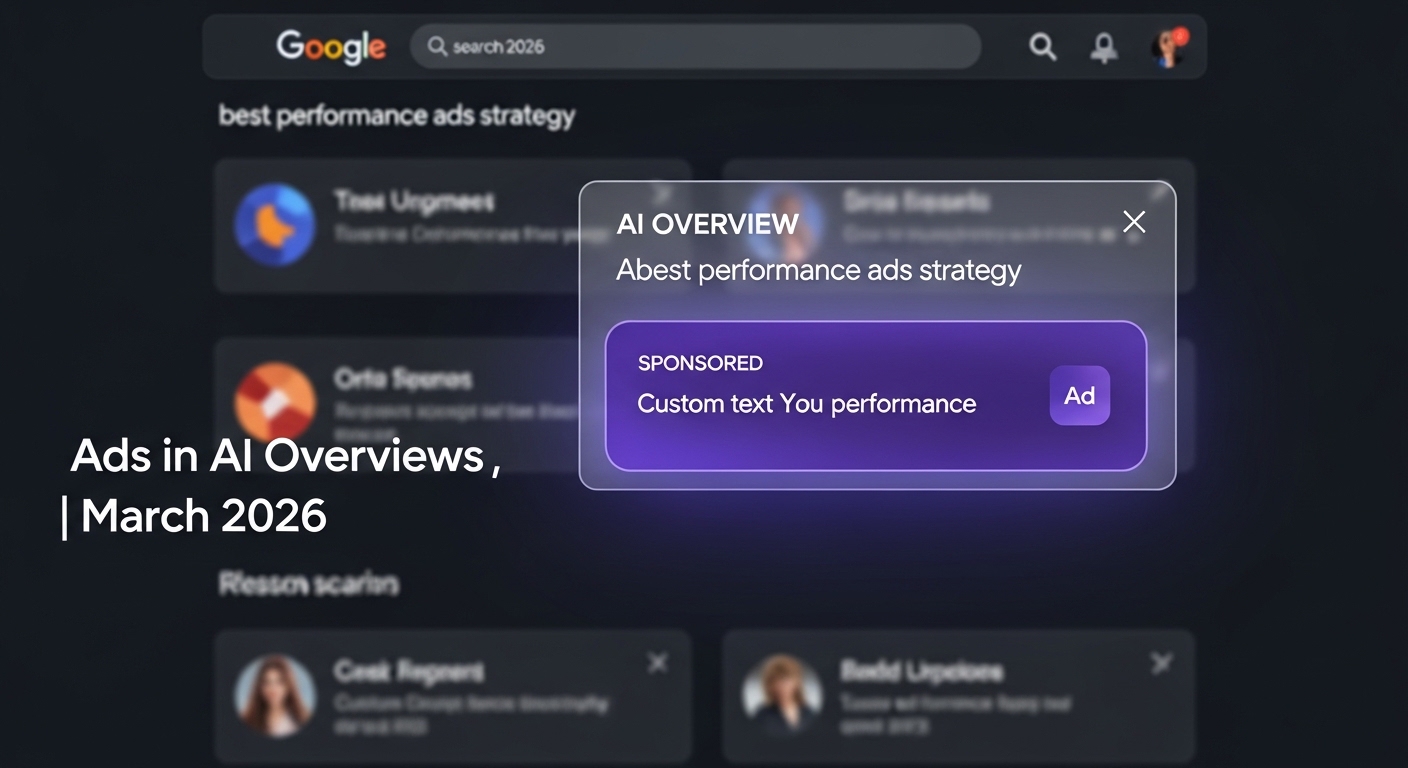
4. Ads Now Appear Inside AI Overviews
Google's AI Overviews — the AI-generated answer blocks that appear at the top of many search results — are no longer ad-free. Ads are now eligible to appear above, below, and in some cases within these AI-generated summaries.
This also has direct implications for your SEO strategy. Organic AI Overview appearances and paid placements within the same SERP now compete and complement each other. Brands with coordinated paid + organic presence will dominate this new real estate.
What This Means for Your Google Ads Strategy in 2026
The shift to AI-first advertising doesn't mean handing over the keys and hoping for the best. It means your role as an advertiser has changed. The levers that matter most are no longer campaign structure and keyword lists — they're data quality, creative assets, and business signal clarity.
Feed the machine better data
Google's AI performs in direct proportion to the quality of signals you give it. Clean conversion tracking, Enhanced Conversions, properly connected CRM data, and Customer Match lists all meaningfully improve how well AI Max and Performance Max can find and convert your best customers.
This is where most accounts fail — not in campaign settings, but in the data infrastructure underneath. If you're unsure whether your tracking is clean, run the free Digital Marketing Scorecard for a 2-minute baseline check across SEO, ads, social, and analytics — or book a free audit for a deeper review.
Invest in creative like it's your primary media buy
Performance Max is a visual-first platform. Your images and videos are no longer supporting assets — they are the targeting mechanism.
- Use high-resolution lifestyle images, not product-only shots
- Create short-form videos (6–15 seconds) specifically for Performance Max
- Avoid relying on Google's auto-generated videos, which consistently underperform custom creative
- Monitor Ad Strength scores — one of your most important campaign health metrics in 2026
Our brand and creative team produces Performance Max-optimised asset packages as part of our advertising engagements.
Establish governance before you scale AI
If you operate in healthcare, aviation, financial services, or any regulated industry, you need Text Guidelines in place before enabling AI Max text customization. Unconstrained AI copy generation in a compliance-sensitive environment is a real liability risk.
Rethink your campaign architecture
The days of dozens of tightly themed ad groups built around exact-match keyword clusters are over. Modern Google Ads accounts should be structured around business objectives and audience segments — not keyword taxonomies.
What Google Ads Looks Like for Your Industry in 2026
DTC E-Commerce
Performance Max is now the dominant campaign type for e-commerce. With a strong product feed, audience signals, and high-quality creative assets, PMax can deliver reach across every Google surface simultaneously. If you're running PMax campaigns structured the same way you did in 2023, you're likely leaving significant ROAS gains on the table.
→ See our E-Commerce Growth services
Healthcare Clinics
AI Max is often the stronger primary vehicle for clinic lead gen. Compliance-safe Text Guidelines + CRM-connected audience signals = qualified appointment bookings at scale. Set up Text Guidelines immediately — AI-generated copy without guardrails creates real compliance liability in healthcare.
→ See our Performance Advertising services
Aviation Services
Aviation is trust-first. AI Max with tight URL controls, brand exclusions, and CRM audience inputs prioritises lead quality over volume — the right approach for high-value, low-volume inquiries. Invest in strong landing pages tailored to specific service lines.
→ See our Lead Generation services
A Practical Checklist: Where to Start
- Audit your conversion tracking — clean, complete, and connected to GA4 and your CRM?
- Enable Enhanced Conversions if you haven't already
- Review Performance Max asset groups — using custom video, or relying on auto-generated assets?
- Configure Text Guidelines if you're in a regulated vertical
- Evaluate whether AI Max for Search makes sense for your highest-value campaigns
- Restructure ad groups around business objectives, not keyword themes
- Check your call-only ads — these will stop serving in February 2027
- Upload your CRM customer list as a Customer Match audience signal
- Review your landing page performance — AI campaigns are only as effective as where they send traffic
- Audit your ad scheduling with the free Ad Timing Optimizer — find your high-ROAS windows and cut wasted spend on dead hours
- Calculate your current ROAS and benchmark it against industry averages by platform — know whether your campaigns are above or below the standard before restructuring
The Bottom Line
Google Ads in 2026 rewards advertisers who understand that automation is not the strategy — it's the environment in which the strategy operates. Your job is to feed it clean data, guide it with clear business goals, and govern it with appropriate guardrails.
The advertisers who treat AI Max and Performance Max as "set it and forget it" tools will see mediocre results. The ones who treat them as high-performance systems that require strong inputs, creative investment, and ongoing governance will compound their advantage over time.
The platform has changed. The question is whether your strategy has. If you're unsure, request a free revenue risk assessment — no strings attached.
Frequently asked questions
What is AI Max for Search?
It is a keyword-free Search campaign type: you provide a landing page, budget, and ROAS or CPA goals, and Google’s AI handles matching and creative variants.
When will Call-only ads end, and what should I use instead?
New Call-only ads can’t be created as of February 2026; existing ones stop serving in February 2027. Move to Responsive Search Ads with Call Assets so Google can optimise when to show click-to-call versus site visits—aligned with AI Max and Smart Bidding.
How do I control brand voice and prevent off-brand AI ad copy?
Use Text Guidelines in Google Ads: term exclusions and messaging restrictions (words or claims to avoid) so AI-generated headlines stay on-brand—especially in healthcare, finance, and other regulated verticals.
Will my ads show up in Google's AI Overviews?
Yes. Ads can appear above, below, or within AI-generated answer blocks. Visibility depends on relevance, auction dynamics, and how well your landing page matches intent.
Is Performance Max right for every business?
Not always. Performance Max works best with strong product feeds, conversion volume, and creative. Many service brands get better results prioritising AI Max for Search when lead quality matters more than volume. Compare e-commerce and lead generation approaches if you’re unsure.
Questions or ready to modernise? Book a strategy call, view performance advertising services, or contact the team.