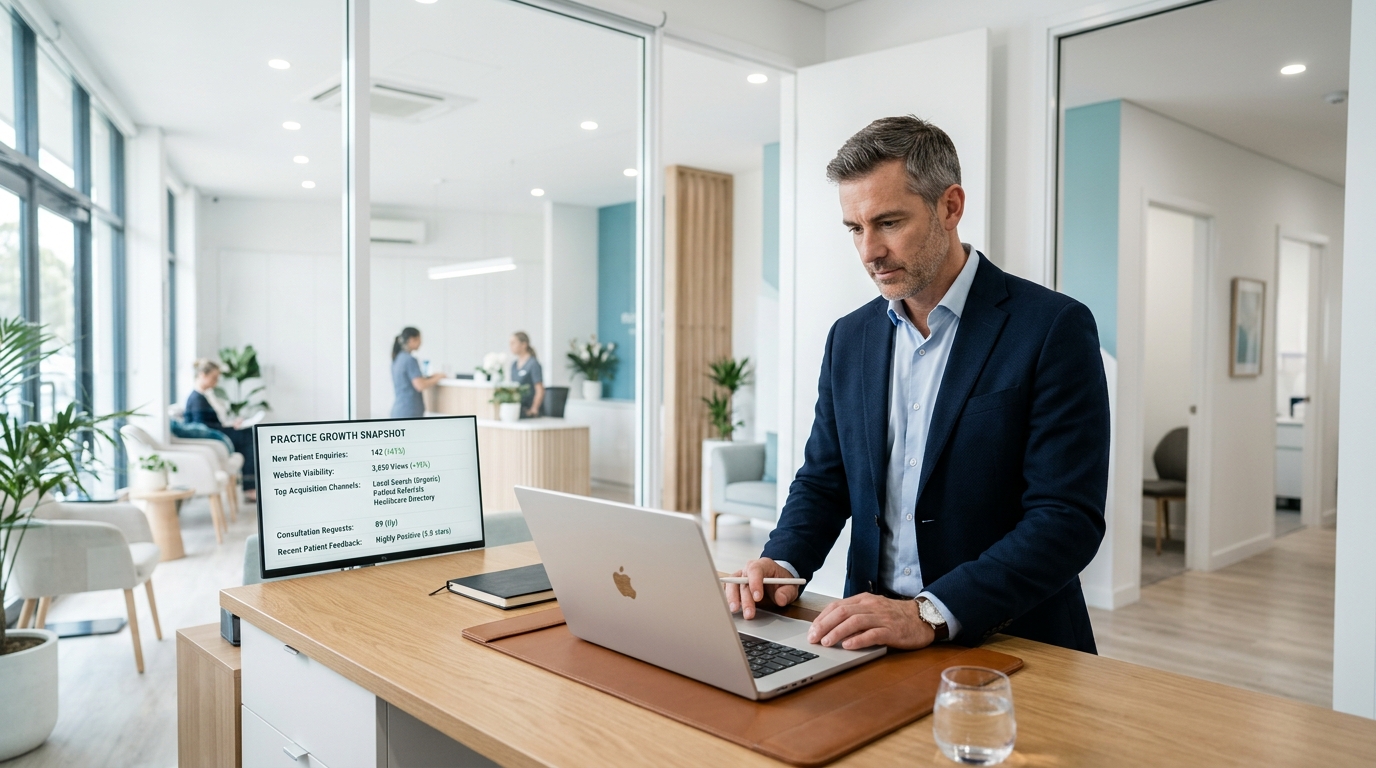

Local SEO for doctors is what determines whether your practice appears when a patient opens Google and types "GP near me" or "best aesthetic clinic in [city]" — or whether a competitor gets that appointment instead. Three clinics appear in the map pack at the top of the results. Below that, another ten appear in the organic listings. Your clinic is not in either. The patient books with one of the three that appeared at the top. They never knew you existed.
This is not a hypothetical. According to Coalition Technologies' analysis of healthcare search data, 77% of patients search online before booking an appointment, with 58% going specifically to Google first. And according to Digital Silk, over 46% of all Google searches carry local intent — meaning nearly half of every search Google processes is a patient looking for something nearby. The practices capturing those searches are not doing anything exotic. They are doing the fundamentals of local SEO correctly while most of their competitors are not.
This guide covers every component — what it is, why it matters for your specific clinic type, and exactly what to do about it.
What Is Local SEO for Doctors and Clinics?
Local SEO is the process of optimising a clinic's online presence to appear in Google search results when patients search for healthcare services nearby. It is different from general SEO because it focuses on location-based queries — "dentist near me," "aesthetic clinic London," "private GP Sharjah" — rather than broad informational searches.
For most private clinics, local SEO drives more new patient enquiries than any other digital channel, including paid advertising. A clinic that ranks in the local map pack receives significantly more patient calls and booking requests than one appearing on page one of organic results below the map. The map pack is the most valuable piece of digital real estate available to a private practice — and it is won through local SEO, not ad spend.
Local SEO covers three interconnected areas: Google Business Profile optimisation, website structure and location-specific content, and external authority signals including citations and reviews. Missing any one of these creates a ceiling on what the others can achieve. If you want to understand why your clinic is not ranking on Google, the gap is almost always in one of these three areas.
For a private clinic, the Google Maps local pack — the three results that appear with a map at the top of local search results — is the most valuable digital real estate available. A clinic in position one of the local pack consistently receives more patient enquiries than one ranking position one in organic results below it.
The 6 Components of Local SEO for Medical Practices
Local SEO for clinics is not one action — it is six interconnected components that compound when implemented together. This section covers each one specifically for healthcare, with examples across dental, GP, aesthetic, dermatology, mental health, and physiotherapy practices.
Component 1: Google Business Profile Optimisation
Google Business Profile is the single most important local SEO asset for any clinic. A fully optimised GBP will outperform a clinic with a better website but a neglected profile almost every time in local search results. Patients are 2.7 times more likely to view a practice as credible when it maintains a complete, professional GBP, and a complete profile directly impacts clinic Google Maps ranking in the local three-pack.
Choosing the right primary category. Getting this wrong is one of the most common reasons a clinic does not appear for the right patient queries. The correct primary category by clinic type is:
- GP or general practice: "Medical Clinic" or "General Practitioner"
- Dental: "Dental Clinic" or "Dentist"
- Aesthetic clinic: "Medical Spa" or "Skin Care Clinic"
- Dermatology: "Dermatologist"
- Mental health: "Mental Health Service" or "Psychologist"
- Physiotherapy: "Physical Therapy Clinic"
Services listing. Every service, condition, and treatment must be listed individually. A mental health clinic that lists only "Counselling" will not appear when a patient searches "CBT near me" or "anxiety therapy." List every service explicitly using patient language, not clinical terminology.
Posting frequency. Google treats GBP posting frequency as a freshness and engagement signal. Clinics that post weekly consistently outperform those that set up their profile once and leave it. One post per week minimum — health tips, service spotlights, seasonal reminders, or team updates.
Photos. Real photos of the reception area, consulting rooms, and medical team consistently produce higher engagement than stock images. Upload a minimum of ten real clinic photos. Patients want to see where they are going before they book.
Q and A section. Populate the GBP Q and A section with your own questions and answers before patients or competitors do. Cover the questions your reception team fields every day — appointment booking, parking, insurance, opening hours, and specific services.
A fully optimised Google Business Profile with regular posts, complete service listings, real photos, and active review management will outperform a clinic with a better website but a neglected GBP almost every time in local search results.
Component 2: Google Maps Ranking Factors
Google uses three core factors to determine which clinics appear in the local map pack. Understanding what controls each one is what turns GBP optimisation from a one-time setup into a systematic competitive advantage.
Relevance is how well your GBP and website match the patient's search query. It is controlled by your GBP category, service listings, and website content. A dental clinic whose GBP lists "teeth whitening," "dental implants," and "Invisalign" as separate services will appear for each of those queries individually. One that lists only "dental services" will not.
Distance is how close your clinic is to the patient's location or the location they searched for. Physical location cannot be changed, but service area content — location-specific pages targeting the neighbourhoods and cities you serve — can extend the geographic reach of your local visibility.
Prominence is how well-known and trusted Google considers your clinic to be. It is controlled by review volume and recency, citation consistency across directories, backlinks from authoritative sources, and GBP engagement signals including clicks, calls, and direction requests.
| Ranking factor | What controls it | How to improve it |
|---|---|---|
| Relevance | GBP category and services | List every service explicitly in patient language |
| Relevance | Website content | Include location and service keywords in page headings |
| Distance | Physical location | Cannot be changed |
| Distance | Service area signals | Build location-specific content pages |
| Prominence | Review volume and recency | Implement a consistent review request system |
| Prominence | Citation consistency | Audit NAP across all directory listings |
| Prominence | Backlinks | List on authoritative health directories |
| Prominence | GBP engagement signals | Post regularly, respond to reviews, add photos |
Component 3: Review Strategy
Reviews are one of the highest-impact local SEO signals for medical practices and one of the most consistently neglected. According to BrightLocal's 2026 Local Consumer Review Survey, 97% of consumers read online reviews and 83% use Google as their primary review platform. For clinic local SEO, this means reviews are both a ranking signal and the primary trust mechanism that converts a patient search into a booking decision.
Review volume and recency both matter — but recency matters more than most clinic owners realise. A clinic with 200 reviews but none in the past six months will lose local pack ranking to a clinic with 40 reviews that receives five new reviews every month. Google weights recency heavily for medical businesses. A static review count is a declining review signal.
How to generate reviews consistently:
- Ask at the point of highest satisfaction — immediately after a successful appointment when the patient is most likely to act.
- Send a follow-up SMS or email within 24 hours with a direct link to the Google review form — not a link to your website.
- Train reception staff to ask verbally at checkout for practices where this fits the patient journey.
- Add a QR code in the reception area that links directly to the Google review form.
- Never offer incentives for reviews. This violates Google's policy and healthcare advertising regulations in most jurisdictions.
Responding to every review. Respond to every review within 24 hours — positive and negative. Google tracks response rate as an engagement signal. A thoughtful, professional response to a negative review demonstrates clinical accountability to every prospective patient who reads it before booking.
Respond to negative reviews professionally and specifically, never defensively. A clinic that handles a critical review well often earns more patient trust than one with only perfect reviews and no responses. Prospective patients read how you respond as much as what they say.
Component 4: Local Citation Building
A citation is any online mention of your clinic's name, address, and phone number — known as NAP — on a third-party website. Google uses citation consistency across the web to confirm that your clinic is a real, established business at a real, verified location.
Inconsistent NAP is one of the most underestimated causes of poor local ranking. Different phone numbers, address formats, or clinic name variations across different platforms split your entity signal. Google cannot confidently associate all of those mentions with a single business, so it discounts them. The result is that a clinic with 30 listings using inconsistent NAP will underperform a competitor with 10 perfectly consistent ones.
Key directories for US clinics:
| Directory | Why it matters |
|---|---|
| Google Business Profile | Primary local ranking signal |
| Healthgrades | High authority US healthcare directory |
| Zocdoc | High traffic patient booking platform |
| WebMD Provider Directory | Authoritative medical entity confirmation |
| Bing Places | Feeds Microsoft Copilot AI local results |
| Apple Maps | iPhone Siri and Maps local search results |
| RateMDs | US-specific medical review and listing platform |
| Yelp | Strong local search presence across all categories |
| Psychology Today | Essential for mental health practices specifically |
Key directories for UAE clinics: DHA Provider Directory (Dubai), HAAD Provider Directory (Abu Dhabi), Shafafiya Portal (Sharjah and Northern Emirates), Okadoc, and Doctify UAE.
The NAP consistency rule: Choose one precise version of your clinic name, address, and phone number and use it identically across every platform. Even minor differences — "Street" versus "St", "Medical Center" versus "Medical Centre" — split your entity signal. For UAE clinics this is particularly important: "Medical Center" and "Medical Centre" on different platforms are treated by Google as two different businesses.
Component 5: Location-Specific Website Content
A clinic website without location-specific content is invisible in local search regardless of how well-designed it looks. Google cannot infer your location from your phone number format or your address in the footer. It needs location signals in your content, your headings, your page titles, and your schema markup — explicitly and consistently.
What location-specific content means in practice: Every key service page should include the city or region naturally in the H1 or opening paragraph, the meta title, and the meta description. The homepage should clearly state the city or cities the clinic serves. For multi-location clinics, each location needs its own dedicated page with unique content — not a copy of the main page with only the city name changed. Duplicate location pages are treated as thin content and suppressed.
Condition and treatment pages by clinic type:
- Dental: dedicated pages for "dental implants [city]," "Invisalign [city]," "teeth whitening [city]"
- Aesthetic: dedicated pages for "botox [city]," "dermal fillers [city]," "body contouring [city]"
- Mental health: dedicated pages for "CBT therapy [city]," "anxiety treatment [city]," "online therapy [state]"
- Physiotherapy: dedicated pages for "sports injury treatment [city]," "back pain physiotherapy [city]"
- GP: dedicated pages for "private GP [city]," "same day GP appointment [city]"
- Dermatology: dedicated pages for "acne treatment [city]," "skin cancer check [city]"
A dermatology practice with a dedicated "acne treatment [city]" page will appear for that query. One with only a generic "dermatology services" overview page will not. The specificity of your content directly determines the specificity of your ranking.
Google cannot infer your location from your phone number format or your address in the footer. It needs those signals in your content, your headings, your page titles, and your schema markup — explicitly and consistently. A service page with no location reference is a page that will not rank for local patient queries.
Component 6: Schema Markup for Medical Practices
Schema markup is code added to your website that tells Google and AI tools exactly what type of business you are, where you are located, what services you offer, and who your doctors are. Without it, Google is inferring your clinic's identity from text alone. With it, Google has structured, machine-readable confirmation of everything it needs to rank and cite you confidently.
The schema types that matter specifically for clinic local SEO are:
MedicalOrganization — the foundation schema every clinic website needs. Confirms you are a legitimate medical entity rather than a website discussing health topics. Includes your name, address, phone number, opening hours, and medical specialty.
Physician — added to each doctor's profile page. Confirms that named, qualified specialists practise at your clinic, which is a critical E-E-A-T and local trust signal for Google's quality evaluation of healthcare content.
FAQPage — added to FAQ sections on service pages. This is one of the fastest routes to appearing in Google AI Overviews and featured snippets for patient queries. Learn more about how FAQPage schema helps clinics appear in Google AI Overviews.
LocalBusiness — confirms your physical location and opening hours to Google's local algorithm. Works alongside MedicalOrganization to reinforce the geographic entity signal.
A clinic with complete schema markup is giving Google a direct answer to every question it has about your business. A clinic without schema is making Google guess — and Google will consistently favour the clinic that makes its job easier.
Real Result: How Local SEO Transformed a Private Clinic's Organic Visibility
Before covering the implementation checklist, here is what these six components produce in a real clinic context.
Clinic: Private multidisciplinary medical center, Sharjah UAE
Specialties: Gynaecology, Paediatrics, Dental, Aesthetics
Starting position: Relying entirely on direct traffic and word of mouth. Organic search was generating almost no patient inquiries. The website had no local SEO structure, no schema markup, and no Google Business Profile optimisation.
What Kozan implemented:
- Google Business Profile fully optimised with all services listed individually across four departments
- MedicalOrganization and FAQPage schema added across key service and department pages
- Featured snippet optimisation on gynaecology and obstetrics service pages
- Location-specific content added to department pages
- Local citation building across UAE health directories
- Review generation process implemented across all departments
Results — Google Analytics 4, January to May comparison:
| Metric | Before | After | Change |
|---|---|---|---|
| Organic sessions | 1,415 | 2,006 | +41.77% |
| Organic traffic share | 34.6% | 53.2% | Now #1 channel |
| Engaged sessions | 953 | 1,275 | +33.79% |
| Engagement rate | — | 63.56% | — |
Every improvement came from structural and content changes, not from increasing ad spend. The clinic did not run a single paid campaign during this period. Every new patient session came from Google finding and surfacing the clinic's content in response to patient search queries.
You can view the full case study results in Kozan's portfolio alongside data from other healthcare and healthtech clients.
Is your clinic invisible in local Google search? Kozan specialises in local SEO for private clinics and medical practices across the US and UAE. Book a free audit and we will show you exactly what is holding your clinic back in local search.
Local SEO Checklist for Private Clinics
Work through this checklist before engaging any agency or making any content investment. Every item here is either a ranking signal in its own right or a prerequisite for the items below it.
Google Business Profile:
- GBP claimed and verified with the correct email account.
- Primary category correctly set for your specific clinic type.
- All services listed individually using patient-friendly language.
- Business description written with services and location named explicitly.
- Opening hours complete, accurate, and updated for public holidays.
- Minimum ten real photos of the clinic interior, reception, and team uploaded.
- Q and A section populated with your most common patient questions.
- Weekly posting schedule in place and maintained.
- Review response system in place — every review responded to within 24 hours.
Website:
- City or region named in the H1 or opening paragraph on every key service page.
- City named in the meta title and meta description on every key service page.
- Dedicated page per location for multi-location clinics with unique content.
- Dedicated pages for high-value treatment queries — for example "dental implants [city]" or "anxiety treatment [city]."
- NAP in the website footer is identical to the GBP listing — same name, same address format, same phone number.
Schema:
- MedicalOrganization schema implemented on the homepage.
- Physician schema on every individual doctor profile page.
- FAQPage schema on every service or department page with an FAQ section.
- LocalBusiness schema with correct address and opening hours.
Citations:
- Listed on Healthgrades, Zocdoc, and WebMD Provider Directory (US clinics).
- Listed on Bing Places and Apple Maps.
- NAP identical across every directory listing — no variations in name, address, or phone number format.
Reviews:
- Review request process in place for every patient interaction.
- Responding to every review within 24 hours.
- Receiving a minimum of two new reviews per month.
Run the free SEO Audit Scorecard to score your website across 6 SEO categories out of 100 — technical, on-page, content, authority, schema, and GEO readiness. Then use the free Digital Marketing Scorecard for a broader view across every channel before deciding where to prioritise.
How Long Does Local SEO Take for a Clinic?
| Action | Expected timeframe |
|---|---|
| GBP optimisation | 2 to 4 weeks for initial local pack improvements |
| Schema markup impact | 4 to 8 weeks for Google to surface structured data |
| Citation consolidation | 6 to 10 weeks for directory signals to consolidate |
| Location page rankings | 8 to 16 weeks for condition and location queries |
| Full measurable impact | 3 to 6 months for meaningful patient acquisition improvement |
A private medical center in Sharjah saw organic sessions increase 41.77% and organic traffic become the number one patient acquisition channel within five months of implementing a structured local SEO programme — with no paid advertising running in parallel. That timeline is consistent with what Kozan sees across healthcare clients in both the US and UAE markets.
Frequently Asked Questions
What is local SEO for doctors and how is it different from regular SEO?
Local SEO for doctors focuses specifically on location-based patient queries — "GP near me," "dentist [city]," "aesthetic clinic near me" — rather than broader informational or national searches. Regular SEO targets a wider range of queries including informational content that may attract readers with no intention of booking. For most private clinics, local SEO for doctors is the higher-priority investment because it captures patients who are already in the right geography and actively looking to book — the highest-intent visitor type available. A patient searching "private dermatologist [city]" is closer to booking than one searching "what causes acne," and local SEO is the channel that captures the former.
How do I get my clinic to appear in the Google Maps local pack?
Clinic Google Maps ranking is determined by three factors: relevance, distance, and prominence. Relevance is controlled by your GBP primary category and service listings — every service you offer should be listed explicitly. Distance is your physical location relative to the searcher, which cannot be changed but can be extended through location-specific content on your website. Prominence is driven by review volume and recency, citation consistency across directories, and GBP engagement signals including clicks and direction requests. The fastest path to local pack improvement for most clinics is completing and optimising the GBP fully — primary category, all services, photos, Q and A — and implementing a review request process immediately.
How many Google reviews does my clinic need to rank locally?
There is no fixed number — Google weights review recency as heavily as volume. A clinic receiving four new reviews per month consistently will outrank one with 200 reviews that stopped growing a year ago. Aim for a minimum of two new reviews per month and respond to every review within 24 hours. The content of reviews also matters for local SEO for doctors — reviews that mention specific services, treatments, or the doctor's name carry more ranking weight than generic five-star ratings with no text. A structured review request process that prompts patients to mention their experience with a specific service produces higher-quality review signals than an open-ended request.
What is the most important local SEO factor for a private clinic?
Google Business Profile is the single most important local SEO asset for any clinic — more than the website for local pack and Google Maps visibility. A clinic with a fully optimised GBP and a basic website will consistently outperform one with a beautiful website and a neglected GBP in local search results. This does not mean the website does not matter — website content and schema are critical for organic rankings and for reinforcing the local entity signals GBP establishes. But if you have limited time and must choose where to start, GBP optimisation produces the fastest visible improvement in local search visibility for clinics at every stage of their SEO journey.
Do I need a separate Google Business Profile for each clinic location?
Yes. Each physical clinic location must have its own separate GBP listing with its own verified address, phone number, and service area. Google does not allow a single GBP to represent multiple locations. Each listing should also have unique photos, posts, and service listings rather than being copied from the main location — duplicate content across GBP listings is treated as thin content and receives less visibility. For multi-location practices, each location page on the website should also be a unique, separately optimised page rather than a template with only the city name changed.
How do I do local SEO for a clinic with no website?
A fully optimised Google Business Profile can generate meaningful local visibility even without a website — particularly for Google Maps and local pack results. For a new clinic with no web presence, completing and verifying the GBP is the immediate priority. However, a website significantly strengthens local rankings by providing location-specific content, schema markup, and entity signals that GBP alone cannot supply. Google uses the website to verify and reinforce the signals your GBP sends — a GBP with a strong corresponding website consistently outranks a GBP with no website in competitive local markets. Even a basic five-page website with a dedicated service page, location content, and MedicalOrganization schema will measurably improve on GBP-only local visibility.
What directories should my clinic be listed on?
For US clinics the essential directories are Google Business Profile, Bing Places, Apple Maps, Healthgrades, Zocdoc, WebMD Provider Directory, RateMDs, and Yelp. For mental health practices, Psychology Today is essential as it functions as a primary patient discovery platform in its own right. For dental and specialist practices, add specialty-specific directories relevant to your clinical area. For UAE clinics, the key platforms are DHA Provider Directory (Dubai), HAAD Provider Directory (Abu Dhabi), Shafafiya Portal (Sharjah and Northern Emirates), Okadoc, and Doctify UAE. NAP must be identical across every listing — choose one version and never deviate from it across any platform.
Can local SEO replace Google Ads for patient acquisition?
Local SEO and Google Ads serve different purposes for clinic patient acquisition and work best together rather than as alternatives. Google Ads delivers immediate visibility and measurable enquiries from day one — which matters during the three to six months before local SEO content begins compounding. Local SEO builds organic visibility that continues generating patient enquiries without ongoing ad spend once established. A clinic that runs Google Ads for immediate pipeline while building local SEO for long-term compounding growth achieves the best patient acquisition cost trajectory — paid PAC stays flat or rises over time while organic PAC falls consistently. The Sharjah medical center referenced in this post achieved a 41.77% increase in organic sessions with zero paid advertising — demonstrating what Kozan's local SEO service for private clinics can produce as a standalone patient acquisition channel.
Local Search Is Where Patients Make Decisions
Local SEO for doctors is not a marketing preference — it is the mechanism by which patients in your city find you or find your competitor. The three clinics in the map pack collect the majority of new patient enquiries from every local healthcare search. The clinics in those positions got there through GBP optimisation, consistent reviews, accurate citations, location-specific content, and schema markup — not through ad spend.
A private medical center in Sharjah implemented exactly these components and grew organic sessions by 41.77% in five months, with organic search overtaking direct traffic as the number one patient acquisition channel. That result is not a one-off — it is what a structured local SEO programme produces when every component is implemented correctly and maintained consistently.
Kozan's patient acquisition service for private clinics covers every component of local SEO from GBP optimisation and schema implementation through to ongoing content production and citation management — for US and UAE clinics that want organic patient acquisition to compound month over month.
Prefer to assess your marketing first? Use our free Digital Marketing Scorecard to get a score out of 100 across every digital channel your clinic currently uses.